Choosing the right egg grading machine capacity is an important investment decision for poultry farms. Buying a machine that is too small can create a processing bottleneck, while choosing a machine that is unnecessarily large may increase the initial investment and operating requirements.
So, which farm size needs a 10,000 eggs/hour egg grading machine?
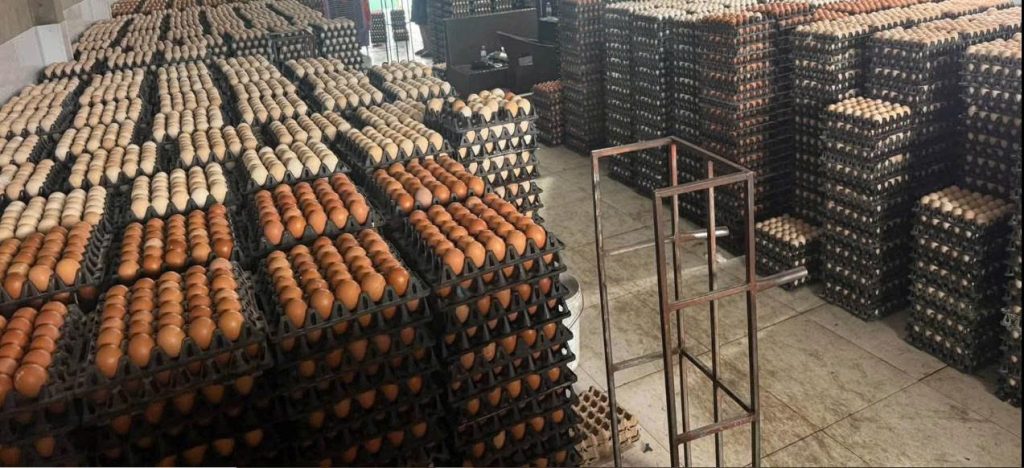
A 10,000 eggs/hour egg grading machine is generally well suited to farms and egg businesses producing around 40,000–70,000 eggs per day. For farms producing approximately 40,000–50,000 eggs per day, the machine can often complete grading within about 4–5 working hours, leaving time for packing, shipping, cleaning, and other daily operations.
However, farm size should not be determined by the number of laying hens alone. Daily egg production, working hours, labor availability, packing requirements, and future expansion should all be considered before selecting an egg grading machine.
What Does a 10,000 Eggs/Hour Egg Grading Machine Mean?
A 10,000 eggs/hour egg grading machine has a nominal processing capacity of up to approximately 10,000 eggs per hour.
This does not mean that a farm must produce exactly 10,000 eggs every hour.
Instead, the machine capacity should be considered together with the farm’s total daily egg production and the number of hours available for grading.
For example:
| Operating Time | Theoretical Daily Capacity |
|---|---|
| 4 hours | 40,000 eggs |
| 5 hours | 50,000 eggs |
| 6 hours | 60,000 eggs |
| 7 hours | 70,000 eggs |
| 8 hours | 80,000 eggs |
These figures are simple capacity calculations based on 10,000 eggs/hour. Actual operating output can vary depending on the production process, machine configuration, egg handling, loading, packing, and other operational factors.
B.H.N’s own analysis similarly shows that a 10,000 eggs/hour machine can process 40,000 eggs in four hours and that farms producing around 40,000–50,000 eggs per day can use the machine without needing to operate the grader continuously throughout the working day.
Which Farm Size Is Best for a 10,000 Eggs/Hour Egg Grading Machine?
For most commercial applications, a practical reference range is approximately 40,000–70,000 eggs per day.
| Daily Egg Production | Recommended Approach |
|---|---|
| Below 25,000 eggs/day | Manual grading or smaller automation may be sufficient |
| 25,000–40,000 eggs/day | Consider automation based on labor and growth plans |
| 40,000–80,000 eggs/day | Strong fit for a 10,000 eggs/hour machine |
| Above 80,000 eggs/day | Consider a higher-capacity system depending on workflow |
This range is a guideline rather than a fixed rule. B.H.N also emphasizes that machine selection should consider daily production, operating hours, available labor, packing requirements, and future expansion rather than flock size alone.
Why Is 40,000 Eggs per Day an Important Point?
Many farm owners assume that a 10,000 eggs/hour egg grading machine is only necessary when a farm produces 80,000 eggs per day.
This is not necessarily the case.
Technically:
10,000 eggs/hour × 8 hours = 80,000 eggs/day
But egg grading is only one part of the daily post-production process.
Farm workers may also need to:
- Collect eggs from the poultry houses
- Transport eggs to the grading area
- Inspect eggs
- Remove damaged eggs
- Grade eggs by weight
- Pack eggs into trays or cartons
- Prepare orders
- Load shipments
- Clean the equipment
- Perform routine maintenance
Because of this, a farm may prefer to complete its grading process within several hours instead of running the machine continuously for an entire working day.
For example, a farm producing 40,000 eggs/day could theoretically complete grading in approximately four hours at the nominal machine capacity.
This allows the remaining working time to be used for packing, logistics, cleaning, maintenance, and other activities.
That is one reason why B.H.N identifies approximately 40,000–50,000 eggs/day as a practical range for farms considering a 10,000 eggs/hour machine.
Is a 10,000 Eggs/Hour Machine Suitable for a 40,000-Egg Farm?
Yes, it can be.
A farm producing around 40,000 eggs per day does not necessarily need a 20,000 or 30,000 eggs/hour machine.
This means the farm could theoretically complete the grading workload in approximately four hours. And your farm has room for future expansion, so the machine will still be suitable when you increase production. You won’t need to upgrade to a higher-capacity machine right away.
For a farm where manual grading is becoming a bottleneck, this can be an attractive level of automation.
A 10,000 eggs/hour system may be particularly worth considering when the farm is experiencing:
- Increasing labor costs
- Difficulty recruiting workers
- Inconsistent manual weight classification
- Slow egg packing
- Increasing daily production
- Larger customer orders
- Requirements for more consistent product classification
The decision should still be based on the farm’s actual workflow and business model rather than capacity alone.
B.H.N’s published guidance identifies 40,000–70,000 eggs/day as a suitable reference range for a 10,000 eggs/hour machine, while noting that actual requirements depend on the farm’s production process and operating conditions.
Should a Farm Producing More Than 70,000 Eggs per Day Choose a Larger Machine?
Not necessarily, but it is worth evaluating.
Suppose a farm produces 90,000 eggs per day.
With a 10,000 eggs/hour machine:
90,000 ÷ 10,000 = 9 hours
The machine could theoretically handle this production, but the farm needs to consider whether operating the grader for approximately nine hours fits its overall workflow.
A higher-capacity machine may be more appropriate if the farm wants to:
- Shorten grading time
- Increase production in the future
- Reduce processing bottlenecks
- Handle larger orders
- Leave more time for packing and logistics
- Build a larger automated processing line
B.H.N offers egg grading systems in multiple capacities, including from 10,000 – 80,000 eggs/hour, allowing capacity to be matched to different production requirements.
Farm Size Is Not the Only Factor to Consider
Choosing an egg grading machine based only on daily egg production can lead to an incomplete investment decision.
Before purchasing a 10,000 eggs/hour egg grading machine, consider at least six factors.
1. Daily Egg Production
This is the starting point.
Calculate your average daily production rather than using the theoretical maximum production of your flock.
2. Working Hours
Ask:
How many hours do we want the grading machine to operate each day?
A farm producing 50,000 eggs/day may prefer five hours of grading rather than running a lower-capacity machine for most of the working day.
3. Labor Availability
Manual egg grading becomes increasingly difficult as production grows.
The farm may need additional workers to maintain processing speed, while manual classification can also create differences between operators.
Automation can reduce dependence on manual sorting and improve process consistency. B.H.N positions its automatic systems as solutions for reducing labor requirements and improving productivity.
4. Packing Requirements
Grading is only one part of the process.
If eggs need to be packed into trays, cartons, or different weight categories, the farm should select a machine configuration that fits its downstream packing process.
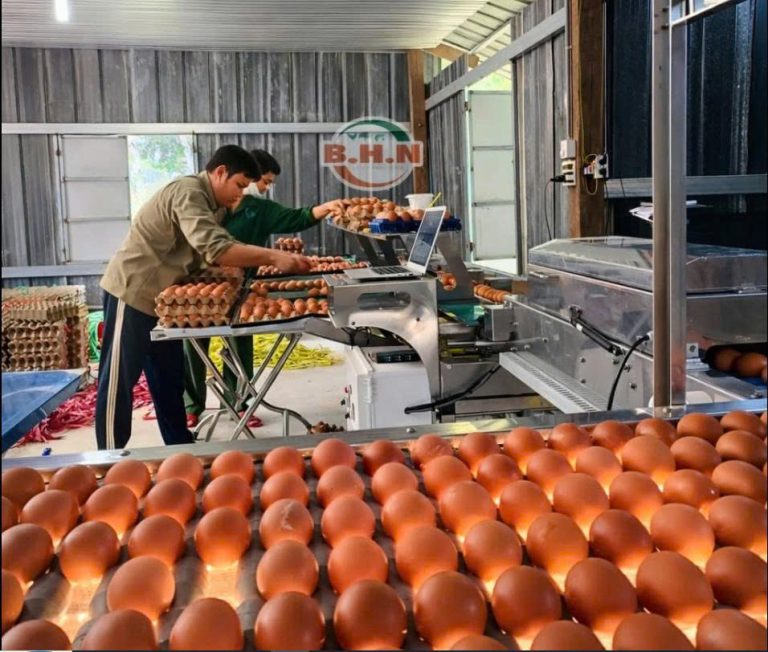
Depending on the configuration, egg grading systems can integrate functions such as egg loading, candling, UV sterilization, weight grading, and automated packing.
5. Future Farm Expansion
Do not select a machine only according to today’s production.
For example, a farm currently producing 35,000 eggs/day may plan to increase production to 50,000–60,000 eggs/day over the next few years.
In this situation, a 10,000 eggs/hour system may make more sense than selecting equipment based solely on today’s lower production volume.
B.H.N recommends considering future expansion when determining machine capacity.
6. Facility Layout
The physical layout of the farm and packing area also matters.
Before purchasing a machine, consider:
- Available installation space
- Egg flow from the farm
- Loading and unloading areas
- Packing area
- Worker movement
- Electrical requirements
- Cleaning access
- Future expansion space
The right capacity is only useful when the machine can be integrated efficiently into the overall workflow.
What Are the Benefits of Automating Egg Grading?
For farms processing tens of thousands of eggs per day, automatic grading can address several problems associated with manual sorting.
1. Faster processing
A 10,000 eggs/hour system can process large daily volumes within a relatively short grading window.
2. More consistent weight classification
Electronic weighing systems can classify eggs according to predefined weight ranges, helping improve consistency.
3. Reduced dependence on manual labor
Automation can reduce the amount of repetitive manual sorting required.
4. Better workflow management
Completing grading in a shorter period can leave more time for packing, shipping, cleaning, and other operations.
5. Easier business expansion
A properly selected machine can provide additional processing capacity as the farm grows.
B.H.N describes its automatic egg grading systems as solutions designed to improve productivity, reduce labor requirements, improve grading consistency, and support commercial egg-processing operations.
Why Choose a B.H.N 10,000 Eggs/Hour Egg Grading Machine?
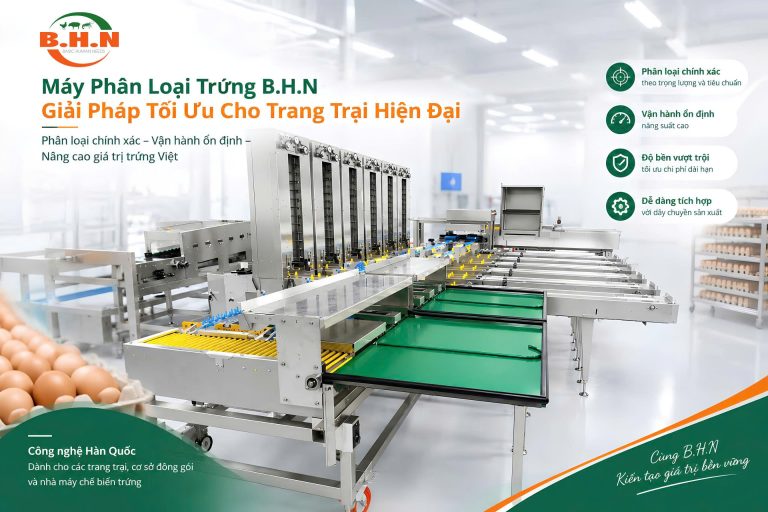
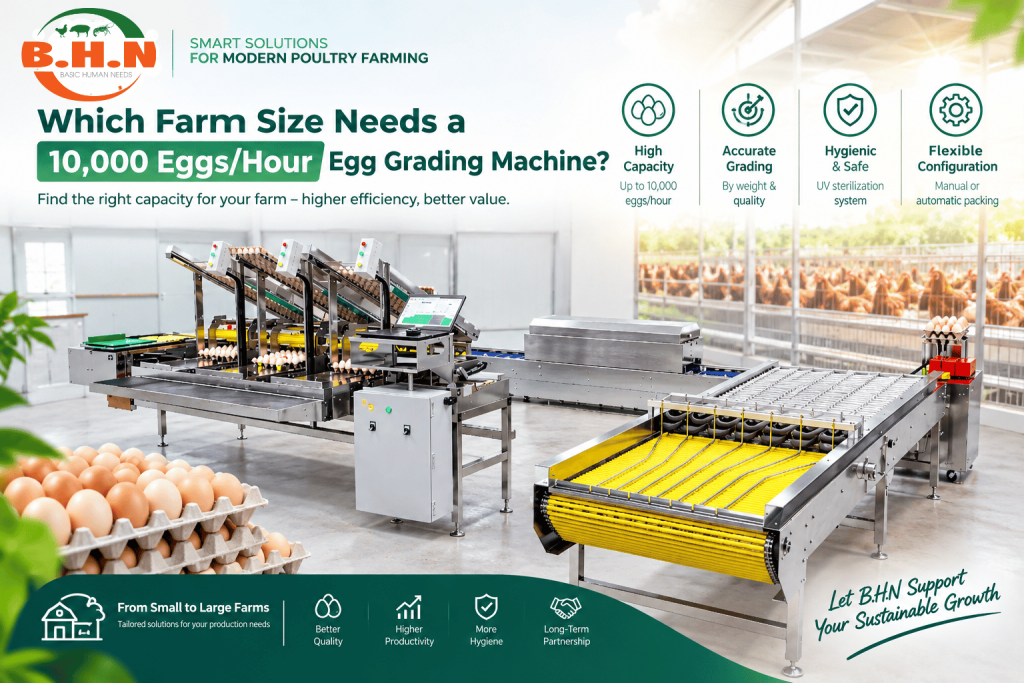
The B.H.N Egg Grading Machine is designed for commercial poultry farms, egg collection businesses, and egg-processing operations that need faster and more consistent grading.
For farms in the approximately 40,000–70,000 eggs/day production range, a 10,000 eggs/hour configuration can provide a practical balance between processing capacity and investment.
Depending on the selected configuration, an egg grading line can incorporate functions such as:
- Egg loading
- Egg inspection
- Weight grading
- UV sterilization
- Egg washing and drying
- Crack detection
- Blood detection
- Automatic packing
- Tray handling
Not every farm needs all of these functions. The appropriate configuration should be selected according to the farm’s production volume, customer requirements, available space, packing method, and future plans.
B.H.N’s product information also emphasizes customizable configurations and different machine capacities for different farm and processing requirements.
10,000 Eggs/Hour vs. Manual Egg Grading
The key question is not simply:
“Can my workers grade this number of eggs?”
A better question is:
“How efficiently can my business grade, pack and deliver this volume every day?”
For a farm producing only a few thousand eggs per day, manual grading may remain practical.
But when production reaches tens of thousands of eggs per day, the business must consider the combined impact of:
Labor + time + consistency + breakage + packing + order fulfillment + future growth.
At this stage, automation can become more attractive from both an operational and long-term business perspective.
Frequently Asked Questions
1. Is a 10,000 eggs/hour egg grading machine suitable for a 40,000-egg farm?
Yes. A farm producing around 40,000 eggs/day can theoretically complete grading in approximately four hours at a nominal capacity of 10,000 eggs/hour. This can make the machine a practical option when manual grading is becoming inefficient.
2. How many laying hens are needed for a 10,000 eggs/hour egg grading machine?
There is no fixed number. It depends on the farm’s actual laying rate. As an illustration, 45,000–60,000 laying hens producing at an average 90% laying rate would generate approximately 40,500–54,000 eggs/day, which can be a suitable range for a 10,000 eggs/hour machine.
3. Can a 10,000 eggs/hour machine process 70,000 eggs per day?
Yes, based on nominal capacity, 70,000 eggs would require approximately seven hours of grading time. Actual throughput depends on the machine configuration and overall production workflow.
4. Does the number of laying hens determine the required machine capacity?
Not by itself. Daily egg production is more important than flock size alone. Hen age, breed, nutrition, management and seasonal conditions can all affect egg output.
Final Recommendation: Is 10,000 Eggs/Hour Right for Your Farm?
If your farm produces approximately 40,000–70,000 eggs per day, a 10,000 eggs/hour egg grading machine can be a strong option.
For example:
- 40,000 eggs/day → approximately 4 hours
- 50,000 eggs/day → approximately 5 hours
- 60,000 eggs/day → approximately 6 hours
- 70,000 eggs/day → approximately 7 hours
The best machine, however, should not be selected based on capacity alone.
Consider your daily egg production, working hours, labor costs, packing requirements, facility layout, customer requirements, and future expansion plans before making the final decision.
For farms that are growing from manual grading toward a more standardized commercial operation, the right 10,000 eggs/hour system can provide a practical step toward higher productivity, more consistent grading, reduced dependence on manual labor, and a more efficient egg-processing workflow.
Looking for the right egg grading machine for your farm?
B.H.N can help you determine the appropriate egg grading capacity based on your daily egg production, farm size, operating schedule, packing requirements, and future expansion plans. Please contact us soon in order to advise!
 Website: bhnenc.com
 Email: bhnenc@gmail.com
 Phone: +84 28 6681 0195
 Zalo: +84 396 298 810
 TikTok: https://tiktok.com/@congtybhn
 YouTube: https://youtube.com/@congtybhn