Understanding the Science Behind One of the Most Advanced Water Treatment Technologies
Water quality plays a critical role in agriculture, aquaculture, livestock production, and industrial water treatment. While many conventional systems focus on filtration or aeration, a newer technology is changing how oxygen is delivered and utilized in water.
This technology is known as Nanobubble Technology.
Unlike conventional aeration systems that produce visible bubbles, Nanobubble Technology generates microscopic gas bubbles with unique physical properties that enable them to remain suspended in water for extended periods. This significantly improves gas transfer efficiency and supports more stable water quality.
At B.H.N Nanobubble Technology, we apply advanced Korean engineering to develop high-performance Nanobubble systems for agriculture, aquaculture, livestock, and water treatment applications.
What Are Nanobubbles?
Nanobubbles are extremely small gas bubbles, typically measuring 80–120 nanometers in diameter.
Because of their nanoscale size, they behave very differently from ordinary air bubbles.
Instead of rapidly floating to the surface and escaping into the atmosphere, Nanobubbles remain suspended in water due to their unique balance of buoyancy, internal pressure, surface tension, and Brownian motion.
This allows oxygen to remain available in the water for much longer, improving oxygen transfer efficiency throughout the entire water body.
How Does Nanobubble Technology Work?
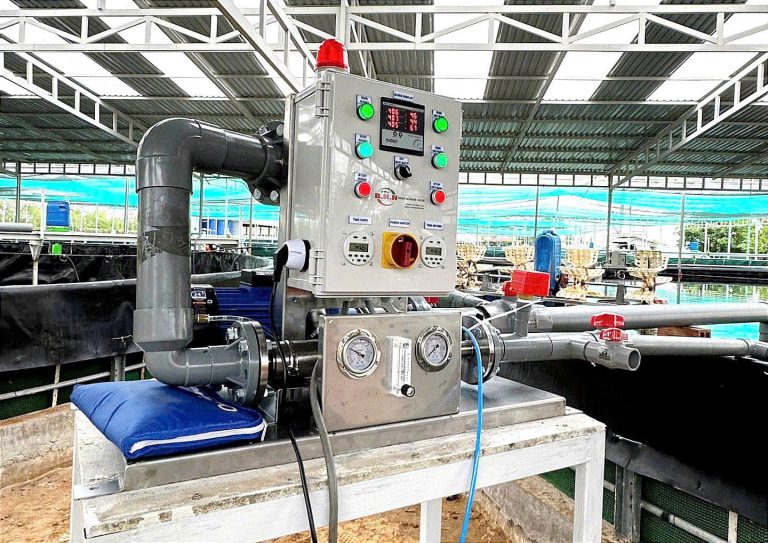
A Nanobubble generator introduces gas—typically oxygen or ozone—into water under controlled conditions, producing stable Nanobubbles.
These Nanobubbles:
- Remain suspended in water for extended periods.
- Move continuously through Brownian motion.
- Deliver dissolved oxygen more efficiently.
- Improve oxygen distribution throughout the water.
- Help maintain more stable dissolved oxygen (DO) levels.
Unlike conventional aeration, the goal is not simply to create more bubbles but to maximize the amount of oxygen that actually dissolves into the water.
Why Is Stable Dissolved Oxygen Important?
In many industries, dissolved oxygen is essential for biological activity.
For example:
Agriculture
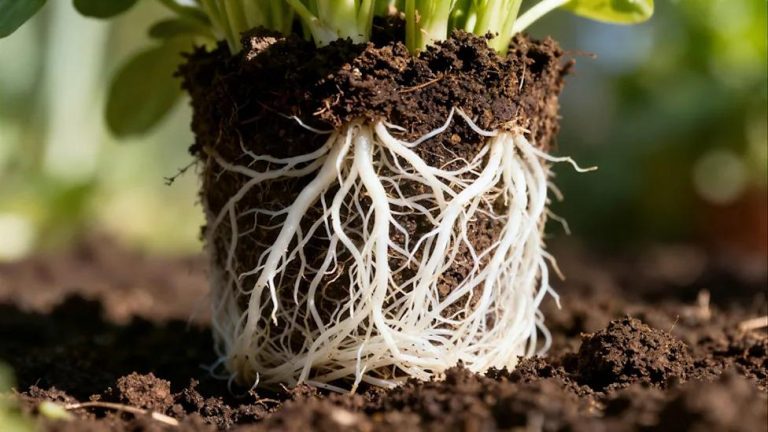
Plant roots require oxygen for cellular respiration to produce ATP, the energy needed for nutrient uptake, water absorption, and healthy root development.
Maintaining adequate dissolved oxygen in the root zone supports stronger root systems and healthier crops.
Aquaculture
Shrimp and fish rely on dissolved oxygen for respiration.
In commercial shrimp farming, maintaining a stable dissolved oxygen level of approximately 7–8 ppm and an oxygen saturation (SAT) of around 100–120% generally provides favorable conditions for growth, feed utilization, and overall pond stability.
The objective is not simply to reach a high DO value but to maintain stable oxygen availability throughout the day and night, reducing stress caused by daily oxygen fluctuations.
Wastewater Treatment
Microorganisms responsible for degrading organic pollutants require oxygen to function efficiently.
Improved oxygen transfer can support biological treatment processes while reducing energy consumption compared with less efficient aeration methods.
Nanobubbles vs. Traditional Aeration
Traditional aeration systems—including diffusers, air stones, paddle wheels, and Venturi injectors—produce relatively large bubbles.
These bubbles rise rapidly to the water surface, limiting the time available for oxygen transfer.
Nanobubbles behave differently.
Because they remain suspended in water for much longer, oxygen has more time to dissolve and distribute throughout the system.
This contributes to:
- Higher oxygen transfer efficiency.
- More uniform oxygen distribution.
- Fewer low-oxygen zones.
- More stable water quality.
Rather than focusing solely on increasing dissolved oxygen at a single point, Nanobubble Technology helps maintain a more consistent oxygen environment across the entire system.
Additional Benefits of Nanobubble Technology
Depending on the gas used and the application, Nanobubble Technology may also help:
- Improve root-zone oxygenation.
- Support healthier aquatic environments.
- Reduce biofilm accumulation.
- Improve water clarity.
- Enhance biological treatment efficiency.
- Reduce reliance on chemical water treatment in certain applications.
System performance depends on operating conditions, water quality, and application requirements.

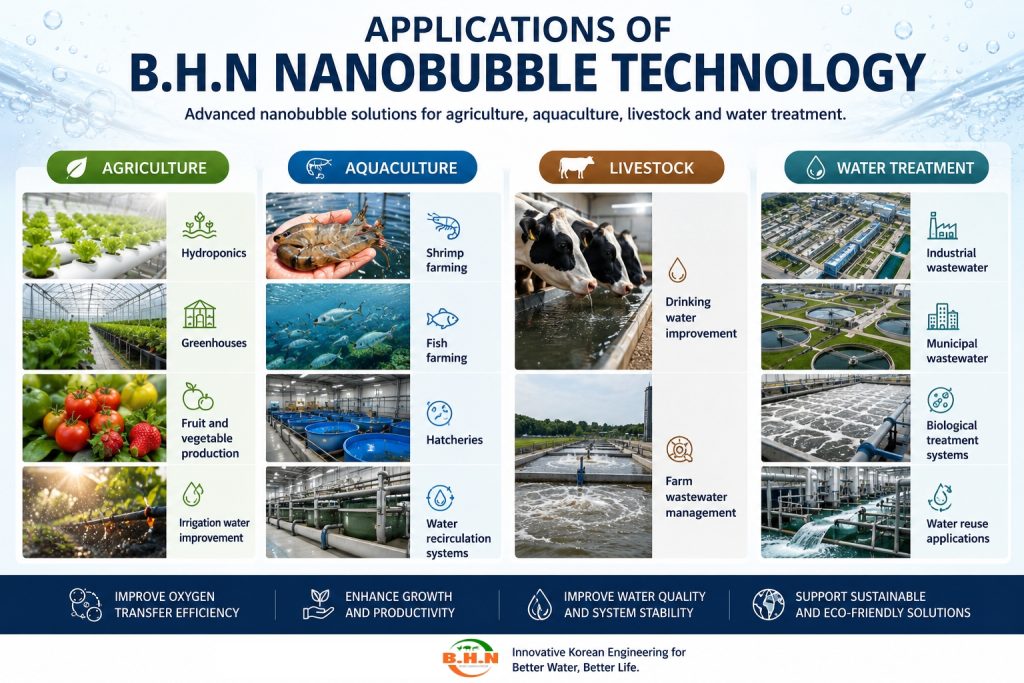
Applications of B.H.N Nanobubble Technology
Our systems are designed for a wide range of industries, including:
🌱 Agriculture
- Hydroponics
- Greenhouses
- Fruit and vegetable production
- Irrigation water improvement
🦐 Aquaculture
- Shrimp farming
- Fish farming
- Hatcheries
- Water recirculation systems
🐄 Livestock
- Drinking water improvement
- Farm wastewater management
💧 Water Treatment
- Industrial wastewater
- Municipal wastewater
- Biological treatment systems
- Water reuse application
Why Choose B.H.N Nanobubble Technology?
At B.H.N Nanobubble Technology, we combine advanced Korean engineering with practical field experience to develop reliable Nanobubble systems for modern agriculture, aquaculture, and water treatment.
Our solutions are designed to help customers:
- Improve dissolved oxygen management.
- Maintain more stable water quality.
- Support healthier biological environments.
- Reduce operating costs through more efficient oxygen utilization.
- Build more sustainable production systems.
Because better water quality begins with better oxygen management.
Frequently Asked Questions
How long do Nanobubbles remain in water?
Unlike conventional bubbles, Nanobubbles can remain suspended in water for extended periods due to their unique physical properties, including Brownian motion and neutral buoyancy.
Is higher dissolved oxygen always better?
Not necessarily. In many applications, maintaining stable dissolved oxygen is more important than reaching the highest possible DO value.
Can Nanobubble Technology be used with oxygen and ozone?
Yes. Depending on the application, Nanobubble generators can operate with oxygen or ozone to support different water treatment objectives.
Learn More About B.H.N
If you’re looking to improve water quality for agriculture, aquaculture, livestock, or wastewater treatment, our engineering team can help recommend a solution tailored to your application.
 Website: www.bhnenc.com
 Email: bhnenc@gmail.com
 Hotline: +84 28 6681 0195