Introduction: FCR Is Not Only About Feed Quality
In shrimp farming, Feed Conversion Ratio (FCR) is one of the most important indicators of farm profitability and production efficiency.
A lower FCR means shrimp can convert feed into biomass more efficiently, reducing feed costs and improving economic returns.
Many farmers focus on selecting high-quality feed, adjusting feeding schedules, and using feed additives to improve FCR. However, one critical factor is often overlooked:
Water quality management.
The truth is: “Healthy shrimp are built through daily farm management and prevention — not by chance.”
A stable aquatic environment, especially proper dissolved oxygen (DO) levels, plays a fundamental role in shrimp appetite, digestion, metabolism, and feed utilization.
The Relationship Between Water Quality and Feed Conversion Ratio (FCR)
Feed does not directly become shrimp biomass. Before growth occurs, shrimp must:
- Detect and consume feed
- Digest nutrients
- Absorb energy and protein
- Convert nutrients into body growth
Every step depends on shrimp health and environmental conditions.
When water quality deteriorates, shrimp experience stress. This affects feeding behavior, digestion efficiency, and energy allocation.
Instead of using energy for growth, stressed shrimp spend more energy on survival and maintaining their internal balance.
As a result:
- Feed consumption decreases
- Digestion efficiency declines
- Growth becomes slower
- FCR increases
How Low Dissolved Oxygen (DO) Can Increase FCR
Dissolved oxygen is one of the most important parameters in shrimp farming.
Oxygen is required for:
- Shrimp respiration
- Energy metabolism
- Nutrient absorption
- Immune function
When DO levels fluctuate or drop, especially during nighttime and early morning, shrimp become stressed.
Common effects include:
1. Reduced Feeding Activity
Shrimp with insufficient oxygen may reduce feeding behavior because their metabolism slows down.
Even when feed is available, shrimp may consume less or digest inefficiently.
2. Poor Nutrient Utilization
Low oxygen conditions reduce metabolic efficiency.
Feed nutrients are not fully converted into growth, leading to more feed waste and higher FCR.
3. Increased Organic Matter Accumulation
Uneaten feed and shrimp waste accumulate on the pond bottom.
This creates a cycle:
Poor oxygen → More organic waste → Worse water quality → Higher stress → Poor feed efficiency
Why Stable Oxygen Levels Matter More Than Temporary Oxygen Peaks
Many farms focus on increasing oxygen only when problems occur.
However, shrimp need stable oxygen conditions every day, not occasional oxygen spikes.
A healthy shrimp pond requires:
- Consistent dissolved oxygen distribution
- Reduced oxygen-depleted zones
- Better bottom water conditions
Maintaining DO around 7–8 ppm throughout the day and night can help create a more stable environment for shrimp growth.
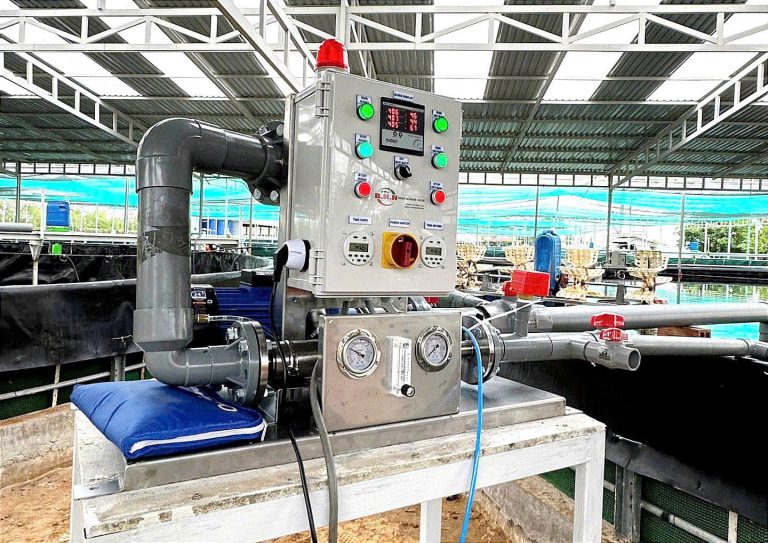
How B.H.N Nanobubble Technology Supports Better Feed Efficiency
Traditional aeration systems mainly transfer oxygen through large bubbles.
However, many oxygen bubbles quickly rise to the surface and escape before fully dissolving.
B.H.N Nanobubble Technology works differently.
Nanobubbles are extremely small gas bubbles, approximately 80–120 nm, which provide:
- Longer residence time in water
- Improved oxygen dissolution efficiency
- More uniform oxygen distribution
Unlike conventional aeration methods, nanobubbles help deliver oxygen more effectively throughout the water column, including areas where oxygen deficiency commonly occurs.
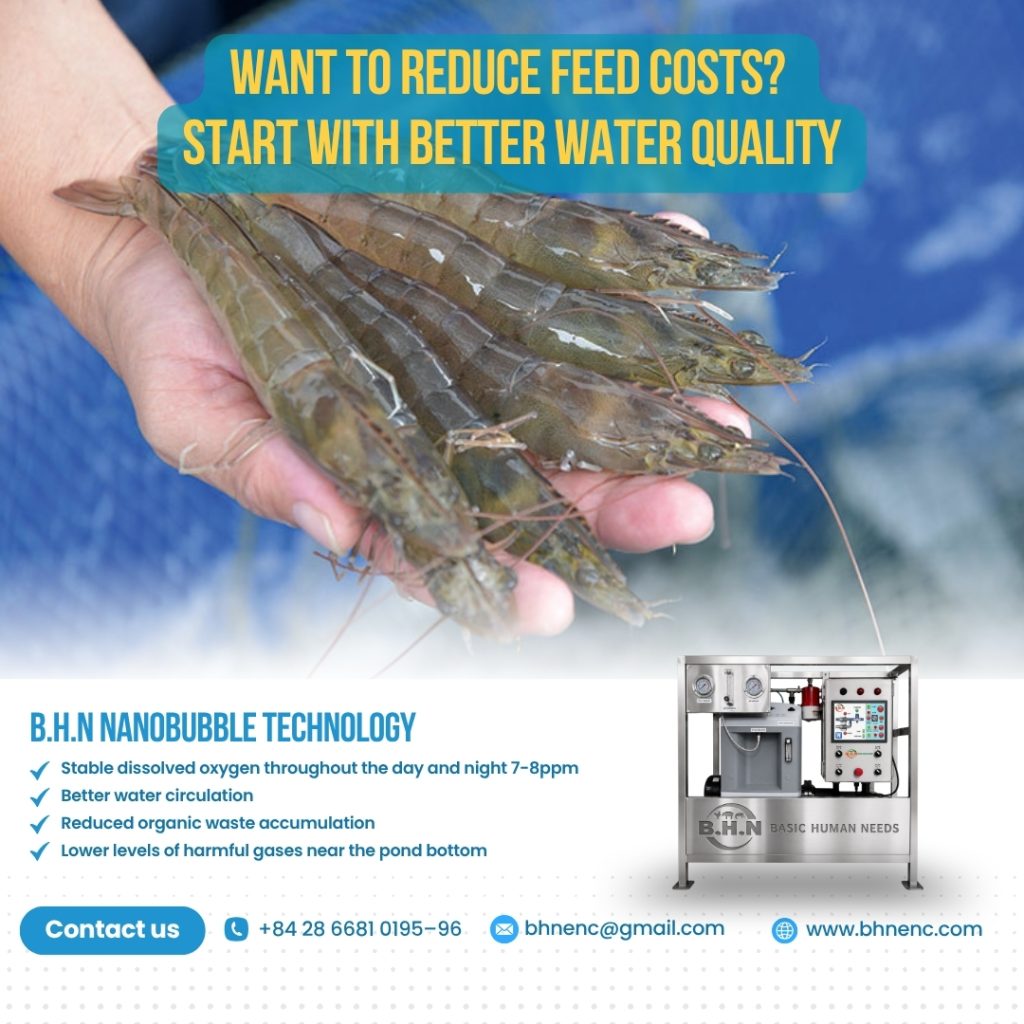
Benefits of Nanobubble Technology for Shrimp Farming
1. Maintaining Stable Dissolved Oxygen Levels
B.H.N Nanobubble Technology helps farms maintain more stable DO levels, supporting shrimp metabolism and continuous feeding activity.
Stable oxygen conditions help shrimp:
✓ Digest feed better
✓ Utilize nutrients more efficiently
✓ Maintain stronger growth performance
2. Improving Pond Bottom Conditions
The pond bottom is where organic waste accumulates.
Low oxygen areas create favorable conditions for harmful bacteria and toxic gases such as:
- Hydrogen sulfide (H₂S)
- Ammonia (NH₃)
By improving oxygen distribution, nanobubbles help create a healthier pond environment and support natural biological processes.
3. Reducing Stress and Supporting Shrimp Health
Shrimp under constant environmental stress often show:
- Reduced appetite
- Uneven growth
- Higher disease susceptibility
A stable water environment allows shrimp to focus energy on growth rather than stress response.
FCR Improvement Starts Before Feeding Management
Many farmers try to improve FCR by adjusting feed quantity alone.
However, feed efficiency begins before shrimp eat.
The real question is:
Is the pond environment allowing shrimp to fully utilize the feed?
Better water quality creates the foundation for:
- Stronger shrimp health
- Better digestion
- Improved nutrient absorption
- More consistent growth
Conclusion: Better Water Quality Creates Better Feed Efficiency
Feed is one of the largest costs in shrimp farming. Improving FCR is not only about choosing better feed — it is about creating the right environment for shrimp to maximize the value of every kilogram of feed.
By maintaining stable dissolved oxygen levels and improving water conditions, B.H.N Nanobubble Technology helps shrimp farms move toward more efficient, sustainable, and predictable production.
Because successful shrimp farming is not built on reacting to problems.
It is built on prevention, daily management, and creating the right conditions for healthy shrimp growth.
Contact B.H.N Co., Ltd.
 Website: www.bhnenc.com
 Email: bhnenc@gmail.com
 Hotline: +84 28 6681 0195/96